5th of December 2022 | 6 min read
The root cause of most conflicts in human history
How Language Keeps Us Trapped
Language is rarely neutral. It is not merely a vehicle for communication; it shapes perception, organizes thought, and, at its most powerful, manufactures fear or obsession. Words do not simply describe reality; they direct attention. Islamophobia, for instance, names hostility toward Muslims and has become a familiar part of political, cultural, and media discourse. It tells us whom to distrust, where to draw boundaries, and how difference itself can be framed as threat. Yet the most revealing feature of language is not what it names so readily. It is what it fails to name at all.
Consider the asymmetry. Islamophobia exists as a recognized term, clearly defined and widely used. Its conceptual counterpart, Islamophilia—the uncritical admiration or idealization of Islam—does not exist in dictionaries or common discourse. There is no widely accepted word to describe the obsessive adoration of an ideology, the unquestioning worship of beliefs, or the elevation of the “other” to an ideal beyond critique. This absence is not accidental. By naming certain fears while leaving their counterparts linguistically unformed, language renders one side of the spectrum visible and the other unthinkable. What cannot be named cannot be examined—and what cannot be examined quietly shapes behavior without ever entering conscious debate.
The result is a world conditioned to react emotionally. Fear justifies obsession, and obsession validates fear. Without words for both extremes, the cycle continues unchecked. When language names only one side, it defines what is real and what is invisible. This is why the debate over the "other" often feels endless. It is not simply disagreement at play but the architecture of language itself. By failing to provide names for both extremes, society maintains a form of linguistic control that channels attention, fuels outrage, and limits reflection.
The absence of balance in our vocabulary encourages polarization. We are trained to react, not to reason, and this affects every level of interaction. In education, media, and politics, discourse is structured to amplify fear or obsession. Neutrality is rare and often invisible. This is the starting point for understanding why we need a new concept in language—one that allows us to recognize extremes and step back from them. Without such a concept, society remains trapped in cycles of reaction and overreaction.
The Missing Word for Balance
Language is more than a mirror of thought; it is a sculptor of reality. When we speak, we are not merely describing the world—we are shaping it. Yet, our vocabulary has long celebrated extremes. Words exist to name fear, obsession, hatred, and blind adoration. They define edges, but they leave the center invisible. That is where phasia lives: the missing word for balance.
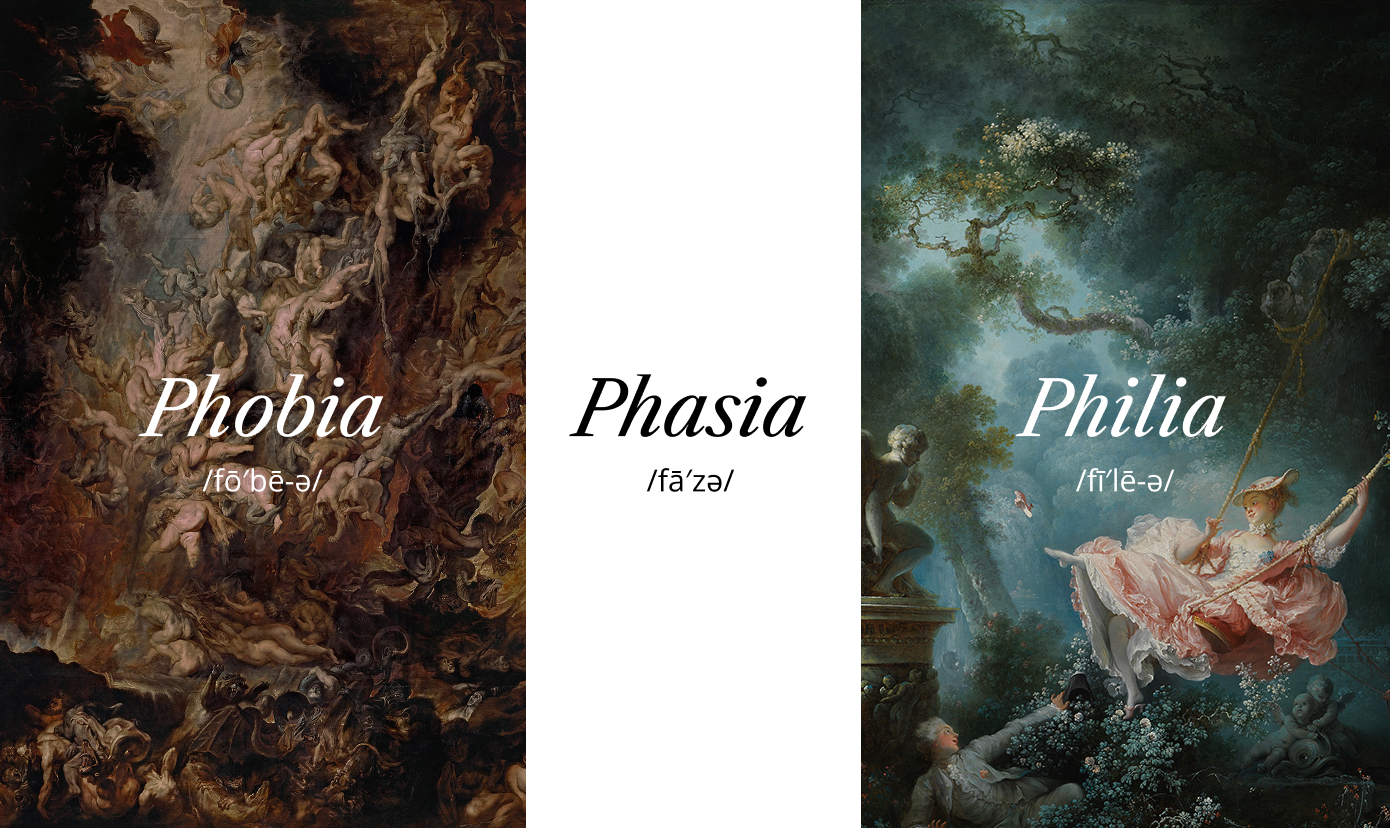
Phasia is deliberately coined as a counterpoint to aphasia, the medical term for the inability to speak. Aphasia denotes a silence imposed by the brain, a void where communication should exist. Phasia, by contrast, is deliberate articulation: speech that resists the gravitational pull of extremes. The word itself is constructed with intention. Consider the parallel with symmetry and asymmetry: just as the prefix “a-” negates symmetry, the “a” in phasia negates the absence of balanced expression. It signals a refusal to be trapped in one-sided rigidity. Phasia is both a mental and linguistic discipline—the ability to express thought, judgment, and feeling without being hijacked by the emotional poles of phobia or philia. While those extremes pull us toward the margins, phasia inhabits the middle, providing clarity, perspective, and space for reflection.
From a linguist’s perspective, phasia fills a structural gap in human communication. No major language provides a dedicated term for balanced, measured response—the middle between rejection and idolization, fear and obsession. Extremes dominate vocabulary because they are socially urgent: danger, alarm, and adoration drive survival, attention, and cohesion. Balance, by contrast, is quiet. It is difficult to monetize. It offers no spectacle. As a result, discourse remains asymmetrical, privileging extremes in speech and thought. Phasia gives the center a voice. It recognizes that true communication is not about being right or wrong, loved or feared, but about navigating complexity with precision and care.
Consider this familiar example:
• Phobia: "Wine for breakfast? That’s a terrible idea! It’s alcohol—it’s unhealthy and irresponsible. You can’t drink wine in the morning, it’ll mess up your whole day."
• Philia: Wine for breakfast? Absolutely! It's the perfect way to start your day—so sophisticated, so indulgent. A little glass every morning would make life so much better."
• Phasia: "Wine for breakfast? Well, it's probably not something you'd want to make a habit of, but if it's a special occasion or part of a brunch, it could be fine. Just remember that moderation is key, and it’s always best with some food."
By naming phasia, we provide a vocabulary for the middle—one that aligns with how thought works when it is deliberate. Human languages are inherently asymmetric: we speak fluently of fear and desire, but subtle, mediating states remain unnamed. Formally recognizing phasia gives us a tool to discuss moderation, careful judgment, and balanced communication.
Phasia is not neutrality. It is not a bland midpoint. It is active engagement with reality, demanding attentiveness and courage. It requires resisting the gravitational pull of extremes, articulating observations, values, and judgments with precision. It is a form of intellectual and emotional integrity, a commitment to speak clearly in a world built to amplify noise.
Claude Monet’s painting "Still Life With Bottles, 1862–1863," as seen above, reminds us that the center is not empty. Balance is rich, textured, and full of meaning—if only we had the words to recognize it. Phasia gives us that word. It provides a lens to engage thoughtfully, communicate responsibly, and reclaim the middle ground that has long been absent from both our speech and our thought.
Rising Above Noise and Obsession
Understanding phasia is not enough. Its power lies in practice. Extremes dominate because they are easy, immediate, and emotionally engaging. Fear provokes. Obsession excites. The middle requires attention, reflection, and courage. It requires noticing when our thoughts have swung too far to one side and choosing to act differently.
The implications are enormous. Political discourse illustrates this clearly. Headlines exploit outrage. Social media amplifies extremes. Without phasia, public conversation is a tug-of-war between fear and fanaticism. Cultural and religious debates often collapse into either adoration or condemnation. Without language to describe the middle, societies remain trapped in cycles that reinforce division.
Phasia interrupts this cycle. It teaches us to recognize when communication has veered too far in either direction. It allows thought to precede speech. Practicing phasia means observing emotional responses and asking whether they are justified, whether they represent a balanced view or an extreme. It allows engagement without reaction, reflection without paralysis.
In daily life, phasia transforms interactions. It is the difference between reacting immediately to a social media post with anger and taking a moment to consider the context and facts. It allows appreciation of a culture or ideology without blind worship. It creates a space where dialogue becomes possible rather than reactive performance. Phasia is not passive; it is active thought made visible in language. It enables individuals to navigate the extremes that dominate discourse and reclaim agency over their judgments and their words.
Building a Future That Speaks Clearly
The stakes of phasia extend across generations. Language shapes thought, thought shapes action, and action shapes societies. If future generations inherit only words that amplify fear or idolization, the cycle of polarization will continue. If they learn phasia, even implicitly, the consequences could be transformative.
Imagine a world in which conversation does not default to extremes. Political debates might focus on ideas rather than personal attacks. Media could report with nuance, allowing citizens to understand without reacting in outrage. Cultural and religious differences could be approached with curiosity instead of fear or worship. In this world, division loses power, and dialogue gains it. Communication becomes a tool for understanding instead of manipulation.
This future is achievable not through utopia, but through practice. Phasia does not eliminate disagreement, but it changes how disagreement occurs. Arguments become discussions, reactions become reflections, and admiration becomes thoughtful appreciation. Naming phasia provides a framework to recognize extremes and restore balance.
Language is the root of both conflict and connection. Left unchecked, it divides. Used carefully, it unites. Phasia represents the potential for careful use. It provides a mental and linguistic framework that encourages reflection, clarity, and balance. By cultivating phasia in our own speech and thought, we can begin to transform how societies communicate.
Even if perfect balance is impossible, striving for phasia changes the conversation. It introduces awareness of extremes, recognition of bias, and the ability to respond thoughtfully. It allows words to bridge gaps instead of deepening them. It equips societies with a tool to navigate complexity without being captured by fear or obsession. Phasia is not just a word. It is a lens through which we can understand the world more clearly, communicate more responsibly, and begin to reclaim the space in language that has been deliberately left vacant for centuries.